Seeing snakes made easy

snakysnakersonHere‘s interesting research on the propensity of humans and other primates to spot snakes, even sneaky ones. Apparently, there’s a Snake Detection Theory that says that our vision has evolved to discern camouflaged but dangerous animals, particularly snakes. To test the Snake Detection Theory, researchers in Japan processed photos of various animals so that they were progressively more blurred; in this way, they could compare how much clarity was needed before research subjects could identify the animal. The other animals were supposedly nonthreatening ones, such as cats and birds. (Not everyone agrees!) They found that people saw snakes in photos that were blurrier than the ones in which they first recognized other animals.

Assuming that the images were truly equivalent, this result bolsters the Snake Detection Theory. And this suggests that, in the evolutionary past, our ancestors lived with individuals who didn’t have this snake-seeing facility and thus died of snakebites before reproducing and passing on their genes.
Chimps can remix behaviors to increase efficiency

The list of distinctive human abilities keeps getting shorter. Once again, our close cousin the chimpanzee has chipped away a bit of our uniqueness. A new study demonstrates that these great apes possess the ability to mix elements of existing techniques to improve efficiency—a part of “cumulative culture.” Continue reading →

Presenting at Nerd Nite DC, 10/8

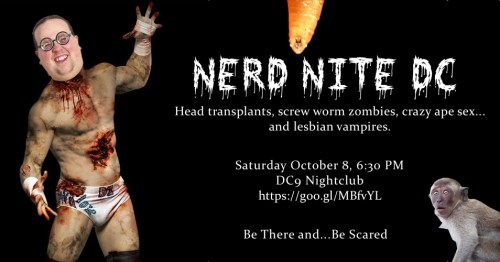
14470576_10209462687218583_1412463759934224376_nThis Saturday evening I’ll unspool an addendum to my novel Bonobo! at Nerd Nite DC. The show starts at 6:30 PM at DC9 Nightclub. Other talks will address head transplants (looks bloody riveting), the screwworm fly, and lesbian vampires. Here’s the blurb for my part:

Our Inner Ape is Human

People share 98+ percent of their genome with chimps and bonobos. So which represents our true human nature? Are we inevitably patriarchal and warlike, like the abstemious chimps – or possibly matriarchal and peaceable, like the randy bonobos? In short, will having sex with everyone all the time produce the new millennium? Maybe! But studying other apes isn’t the way to answer the question. I’ll explain why, to understand human possibilities, we should focus on … people. Along the way, I’ll touch on the evolution, genetics, and comparative behavior of chimps, bonobos, and humans.


Condoms in, condoms out

From early on, I knew that my novel would include various – okay numerous – scenes of sex. But I thought about Bonobo! for several years, wrote large chunks, and plotted the whole shebang with hardly a prophylactic. Nonetheless, the text eventually ended up with almost fifty mentions of condoms. What changed?

Writing Bonobo! was my work when I wasn’t performing other jobs: college professor, editor, or researcher-for-hire. For example, while living in Uganda, I convinced a public-health organization to fund research on HIV-prevention from a novel perspective. As a pilot project, they contracted me to conduct a systematic review of research explaining patterns of condom-use in five African countries. So on the one hand I was writing a novel that included orgies and a lot of impromptu sex, while on the other I was focused on how to encourage people to use condoms.

On yet another hand, I couldn’t help but notice that young Ugandans seemed to pay much, much more attention to popular music than to public-health campaigns. What would be really effective, I hypothesized, is if rappers and dancehall artists were to drape condom packages on the gold chains around their necks or to brag about how many condoms they used per day (per capita?). It shouldn’t be some pasteurized, foreign-funded All-Star sing-along but a seemingly autochthonous amalgam of nastiness and prudence.

No one would confuse my philosophical bildungsroman for a literary rap video, but I knew that I had to put my novel where my mouth was. In time, condoms came to have a metaphorical role in the story as well. But it started from research and the desire to contribute what little I could to condoms’ cachet.

Sarah Stone: My best writing coach

To write my novel, Bonobo!, I sought different kinds of training and feedback. I worked through a variety of texts, participated in several Meetup groups, and requested critiques from family and friends. The least-helpful feedback I got was from someone at a Meetup who wrote only, “Start over.” I guess that beats, “Give up.”

No one went to the other extreme, editing my work the way that legendary editors of yore did for, say, Harper Lee. The most productive thing I did was take a class on novel-writing from Sarah Stone through Stanford’s Continuing Studies program. Continue reading →

Orlando reactions: Where is the love?

After a gunman shot at the back of my head from a few feet away and, amazingly, missed, I thought a lot about what would have happened if I’d been killed. I never imagined that people would skip past the tragedy of my death to debate the shooter’s motives and access to guns. Continue reading →

Another “Bonobo”?!

BonoboFilmSoon after I published my novel, Bonobo!, I searched for the title on Amazon to see what came up. To my surprise, I found a film titled Bonobo (no exclamation point), which had been released recently, too. Clearly, this idea’s time had arrived.

So I watched it. Continue reading →

Could your back infection be metaphorical?

A Hologram for the King isn’t an especially good or bad film. Perhaps the most interesting aspect, for me, was the main character’s back infection. Having these while living overseas has become almost a hobby for me. So, as soon as the giant lump on Tom Hanks’ character’s (THC’s) back was revealed – while he was in Saudi Arabia, no less – I stopped scrolling through my Facebook feed and practically watched with attention.

Well, THC goes to the doctor, and she tells him, in so many words: we need to see whether this is the kind of back infection that Tracy gets or whether it’s metaphorical. The rest of the film made clear the differences between the two. To save you some money, here’s a synopsis: Continue reading →

ME/CFS Awareness Day: Some basics

On Sept. 17, 2010, I fell ill and, barring a medical miracle, will never fully recover. It took more than three years to get a diagnosis: “chronic neuroimmune dysfunction,” better known as chronic fatigue syndrome or myalgic encephalomyelitis. Since it’s ME/CFS Awareness Day, I thought I’d share some basic information about this disease. Continue reading →

Converting a Word doc to a PDF

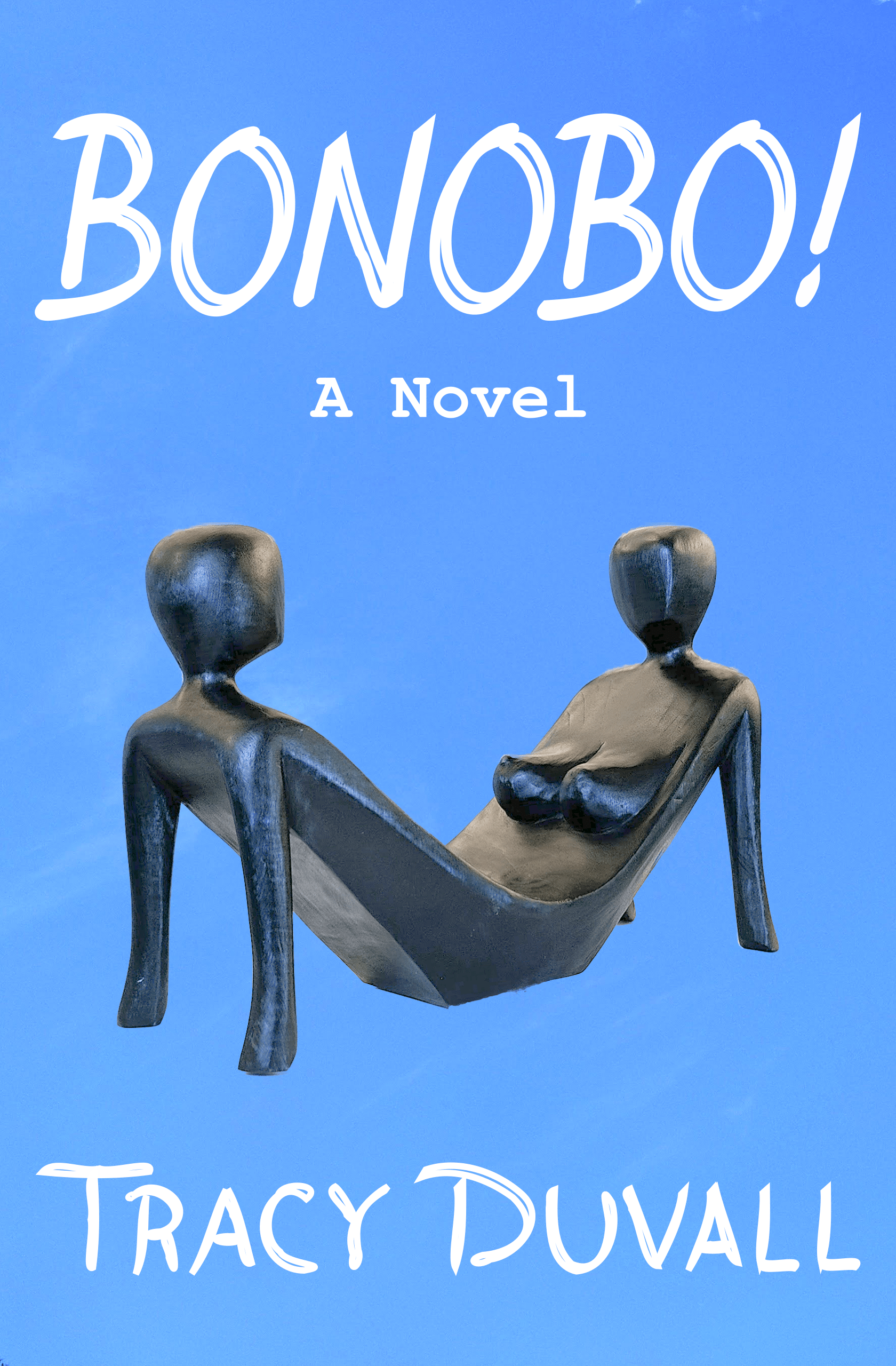
To publish my novel, Bonobo!, on CreateSpace, I needed to convert the text file from Word 2010 to a PDF file. The PDF had to have all the fonts embedded, no changed characters, and images at least 300 dpi. The only images in my file were on the title page. I tried four methods that failed before I found the (free!) solution: PDF995. However, this utility still required some tweaking. Continue reading →