
Category Archives: ME/CFS

ME/CFS Research Chatbot

Introducing the ME/CFS Research Chatbot!  It’s meant to provide a reliable, accurate, and up-to-date summary of published research for the general public.

While general LLMs like ChatGPT and Claude might provide fine answers to queries about myalgic encephalomyelitis/chronic fatigue syndrome, the sources are often unreported or of unknown quality, and the chatbots are prone to hallucination and to change answers from one moment to the next.

The chatbot that I have designed is a bit different: It relies only on research abstracts from the NIH’s PubMed database that address this disease, it can provide a list of the abstracts consulted, and it’s designed to provide the same, ‘best’ answer each time a particular question is asked – including admitting ignorance, if information is lacking.

Continue reading
Can tracker readings predict daily health for PWME?

How well can the tracker data that’s available to me upon waking foretell my health status, as a person with ME/CFS (PWME), for the rest of the day? Over the past few years, I have applied a plethora of machine learning techniques to answer this question. The goal was to create an app to automatically predict PWME’s daily health each morning.

The result is disappointing: the best method will accurately predict whether my daily health will be ‘bad’ or ‘not bad’ only 57 percent of the time. Flipping a coin would result in 50 percent accuracy, so this is an improvement of only 7 percent.

I still believe that resting heart rate (RHR) and heart rate variability (HRV) generally change along with my health status, so what went wrong? My observation is that many other factors also influence these measurements, masking the relationship that I’m trying to model. The good-ish news is that a person likely can do a better job of taking these contingencies into account, making this a case when human learning probably outperforms machine learning.

Continue reading

Spoonie? Balloonie? Debit cardie!

Like anyone with ME/CFS, I have a harder limit on my daily activities than most people do. Not only do I have little capacity at each moment, but exceeding an unknown threshold will result in ‘post-exertional malaise‘ (PEM: a significant worsening of my condition) a couple of days later. To describe these limits on our energy, many people with chronic diseases like to call themselves spoonies. This term refers to energy depletion through the odd metaphor of a spoon supply being used up. I think we can find a better term.

One of the problems I have with the metaphor of spoons is that I’m simply not concerned about using up actual spoons on a daily basis. In fact, I reuse spoons all the time (generally, after washing them). And the real-world penalty for running out of spoons doesn’t seem so onerous.

Continue reading

How I measure HR and HRV

Elsewhere I explain how I use my heart rate (HR) to manage my chronic disease. In this post, I will describe my equipment, which also allows me to monitor my heart-rate variability (HRV). In short, I pair a Garmin Vivoactive 3 smartwatch to a Wahoo Tickr Fit armband; the watch measures HRV well but does a poor job with HR during low-level activity—which is about all I do.

Here are the details, including reasons for not choosing competing products: Continue reading

Monitoring my heart rate to manage ME/CFS

One of the basic bits of advice for people with ME/CFS is, “Don’t overdo it.” But, given the delayed reaction of PEM (post-exertional malaise), how can we know whether we’re exerting ourselves too much? Some medical professionals urge patients to monitor their pulse, or heart rate (HR), to stay within their energy envelope. Like many others, I follow this advice. But I believe that the focus on HR, and especially on a specific rate of beats per minute (BPM), is simplistic and actually can lead to ‘overdoing it.’

The first reason to not depend solely on heart rate is that psychological stress can cause PEM, too. This stress can be due to positive or negative situations, and the heart rate doesn’t have to rise as high as it does during overexertion to cause PEM. For example, while teaching a college class for 80 minutes twice a week (my only real activity), I feel low-level excitement, and my HR stays well below the rate that I can sustain for that length. Yet this excitement causes PEM. So exertion isn’t everything. (It would be great if researchers addressed this.)

The rest of this post discusses my approach to managing my exertion using heart rate. I list the equipment I use in another post. Continue reading

ME/CFS, Valcyte, and me: Third time lucky

In this post, I describe my improvement—and problems—while on valganciclovir, aka Valcyte. Before deciding to take this powerful but dangerous medication, I read a lot of other patients’ accounts, and I hope that my experience will help others in the same way.

Do herpes viruses cause or contribute to ME/CFS? This question continues to roil researchers, medical specialists, and patients. My evolving belief is that they do contribute in some but not all casesand certainly in mine. One reason reason for this belief is my experience on antivirals, especially Valcyte.

The big picture

I’ve taken valganciclovir three times and had three different results, but each time at least one symptom-trigger disappeared. Under my current regimen, I’m able to teach a college course, which is a wonderful resurrection. Continue reading

Eriksen’s ME/CFS Hypothesis: An Update

In June 2017, I put out a series of blog posts about Dr. Willy Eriksen’s hypothesis regarding the causes and potential treatment of ME/CFS (myalgic encephalomyelitis, aka chronic fatigue syndrome): summary, interview, and reaction. Now, in September 2018, Dr. Eriksen has provided an update:

Has your hypothesis changed since you published it?

No, my hypothesis is the same. So far, I have not seen any study results that have convinced me that the hypothesis is wrong.

Have your ideas regarding potential treatments changed? Continue reading

Notes on lobbying Congress for ME/CFS funding

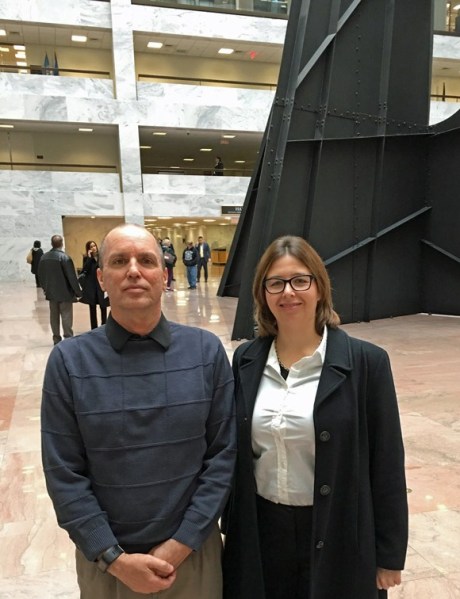
Hart-Senate-LobbyOn March 6, I accompanied the irrepressible Emily Taylor of the Solve ME/CFS Initiative to lobby members of Congress. Specifically, we urged them to add ME/CFS (myalgic encephalomyelitis, or chronic fatigue syndrome) to a list of diseases eligible for research funding from the Department of Defense. This post contains some reflections on the experience. Continue reading

ME/CFS: Thiamine is key; coffee & tea inhibit it

As I’ve noted elsewhere, thiamine forms part of a suite of supplements that might counteract energy problems in ME/CFS. In any case, thiamine (or thiamin) is vital to energy production and other biological processes.

A lot of people think that coffee or tea is vital to getting enough energy, too. For years I was one of those people, and I looked for the instant tea with the highest tea and caffeine content. Yet I noticed over many hiatuses from tea – but not caffeine – that I actually felt moderately better without it. How could this be?

It turns out that tea, coffee, raw shellfish, raw freshwater fish, and other foods contain “anti-thiamine factors.” Continue reading

ME/CFS: My medications and supplements

Finding and affording a specialist for myalgic encephalomyelitis (aka chronic fatigue syndrome) is difficult, and the two I’ve consulted have different approaches. So I thought I’d share some of my experience.

Hopefully, the following list will help other people with the disease. Each item is on it due to either a doctor’s recommendation or a research finding.

Continue reading